
Table of Contents
Key Use Cases
- See each driver’s assignment timeline: current trip, planned trips, gaps, and time off, across a multi-day horizon.
- Plan by day in the Calendar view to see what each driver is doing on each day of the week.
- Spot delays, low-utilization warnings, and availability gaps at a glance.
- Create time off by selecting empty space on a driver’s timeline.
- Assign available trips to drivers, and run optimization from a gap or for several drivers at once.
- Track fleet health through footer KPIs.
Navigation overview
Access Dispatch under Planning > Dispatch. Dispatch has three display modes, toggled at the top of the module: Gantt (the default), Calendar, and Grid. Switching modes keeps your drivers, filters, and search.
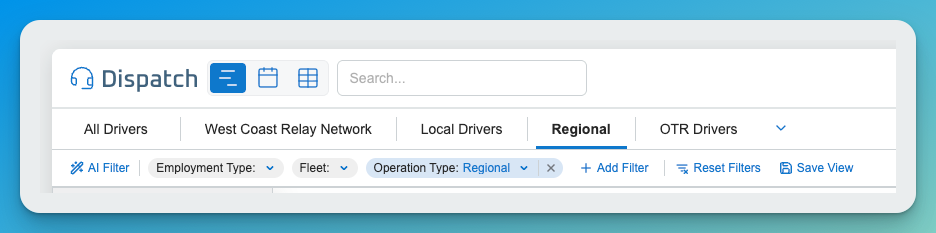
Saved view tabs run across the top (for example, All Drivers or a regional group), with a filter bar beneath them. An optional Trips panel can be docked below the driver list. Using a button in the upper right header.
Gantt Timeline View
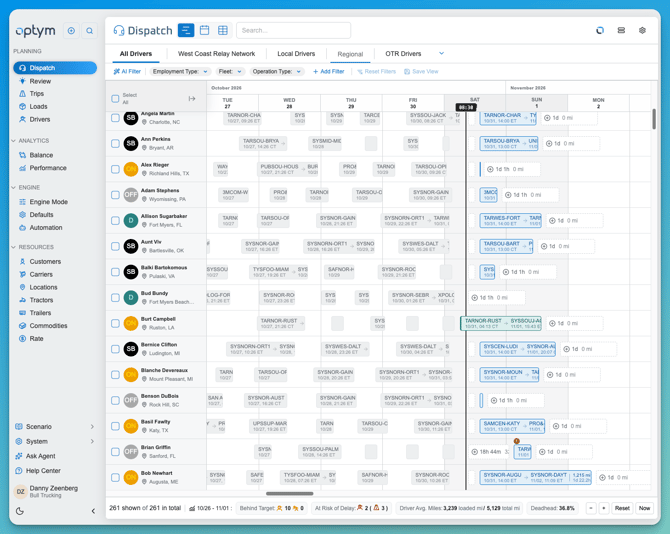
The Gantt shows one row per driver against a time axis, with a vertical line marking the current time. Each row shows that driver’s assignments as bars and gaps:
- Trip bars show current and planned trips with origin and destination, mileage, and appointment times.
- Delay badges (for example, “1h 42m delay”) flag trips running behind.
- Warning badges (for example, Low Utilization) flag planning issues.
- Gaps are open stretches of availability between assignments.
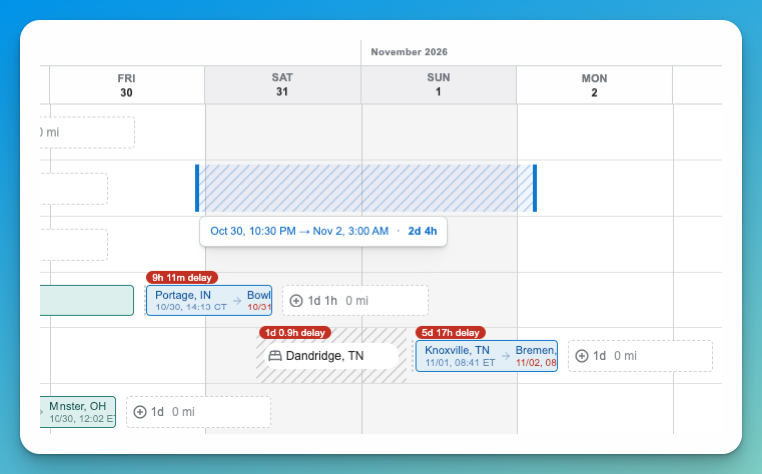
- Time off appears inline on the timeline as hashed blocks.
Driver details. Hover over or select a driver to see their name, fleet, employment and operation type, status, tractor, home and domicile locations, last-seen (ELD) location and time, next availability, and Hours of Service remaining.
Gap details. Select a gap to see the shift drive time remaining at the gap start, time until reset, the gap’s start and end, its distance and duration, total drive time, and idle time. A gap is also where you start optimization for that driver.
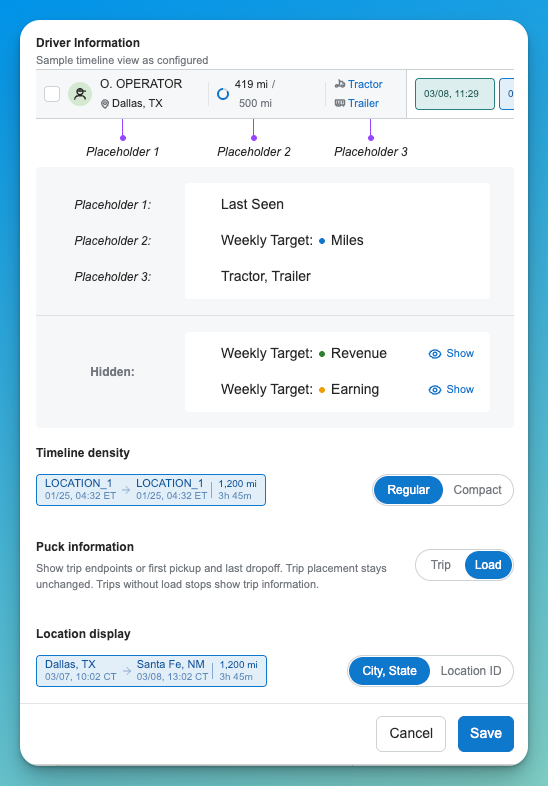
Customizing the Gantt. Use the settings dialog to choose what each driver bar shows (such as Last Seen, Tractor/Trailer, and weekly target metrics for Miles, Revenue, or Earnings) and which location identifier appears (City/State or Location ID).
Calendar View
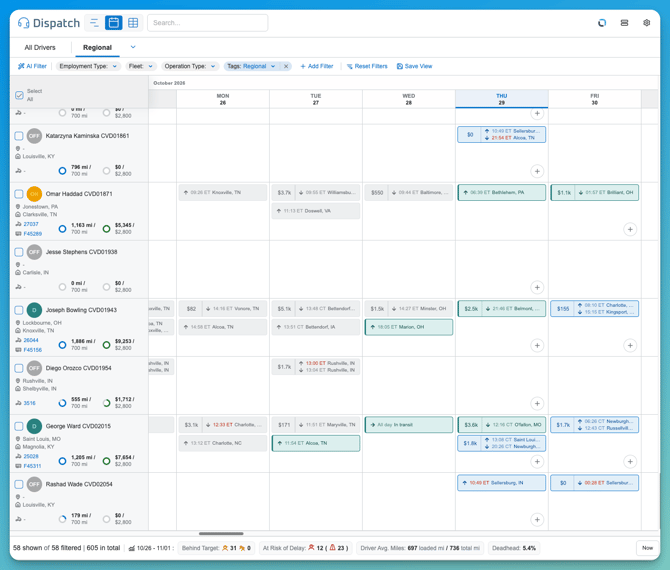
The Calendar shows your trips day by day. Driver rows run down the side and days run across the top, with each driver’s trips shown on the day they happen alongside their driver summary and non-trip activities such as time off. Drag and drop trips to assign or reassign them.
- Use the timeline view options to choose how locations and trips or loads are labeled, matching the options on the Gantt.
- The calendar keeps the date you are viewing when you change views.
- One chip per trip per day, with multi-day trips shown on every day they span; a “+N more” link when a day holds more trips than fit; Home, Transit, Time Off, and idle days shown as their own entries; per-driver revenue, miles and $/mile totals for the visible range; a marker on today’s date; and date navigation (Today, previous/next).
Grid View
The Grid lists drivers in a sortable table. Trip references link to the trip itself, and you can show, hide and reorder columns.
| Group | Columns |
|---|---|
| Identity and status | Tags, Driver Ref. #, Name, Status, # Trips, Trip Assignments |
| Location and ELD | Last Location, ELD Updated Date, ELD Status, Remaining Shift Driving |
| Availability and next work | Next Available Date/Time/Location/City/State/Zone, Current Trip, Next Trip, Next Trip In, PTA |
| Equipment and assignment | Tractor, Trailer, Driver Manager, Fleet, Op. Mode |
| Driver attributes | Emp. Type, Op. Type, Domicile Location, Home, Home City, Home State, Class, Notes, Remaining Shift Duty |
| Mileage and targets | Actual Miles, Target Miles, ETA to Next Stop, Time to Next Stop |
| Current and next trip | Customer, Origin and Destination State/Province, Zone, and Appointment, for each of the current and next trip |
| Equipment requirement | Trailer Type |
Creating Time Off
You can create time off right on the Gantt.
- Drag across empty space on a driver’s timeline to select a time range.
- The Create Time Off form opens with the times filled in. The range snaps to 15-minute increments, and you can adjust the start and end times precisely in the form.
- Choose a Time Off Location, or leave it blank. For solo drivers the options are their Home, Domicile and Parking locations; for team drivers, the Primary and Secondary drivers’ Home, Domicile and Parking locations. The same options appear when you use Driver Details > Schedule > Add Time Off.
- Save. The form closes after a successful save.
The time off status is set from your selected range. If the range ends before the current time, it is Completed; if it spans the current time, it is In Progress; if it starts after the current time, it is Planned.
Filtering and Saved Views
- Saved views scope the driver set and are shared with the Balance module. Create and manage them with Manage Views (pin, rename, duplicate, delete, and set visibility).
- Filter bar chips include Employment Type, Fleet, Operation Type, Next Available Location, Tags, and Solo/Team, plus Add Filter, Reset Filters and Save View.
- The Domicile Location filter uses a driver’s Home Location when no domicile is set.
Assigning and Optimizing
- Run optimization. Select one or more unassigned loads or trips and click Evaluate. Trips are generated using feasibility, profitability, and driver preferences. You can also start from a gap on the Gantt, or select several drivers for bulk optimization.
- Review suggestions. Each Trip Card shows metrics such as cost per mile, deadhead miles, driver utilization %, and delays. Expand each KPI to see how it was calculated.
- Assign a trip. Click Save to TMS to confirm a suggested trip. Use Manually Assign to assign or swap drivers yourself, or assign from the Available Trips panel without leaving Dispatch.
- Handle exceptions. View alerts such as missed appointments, driver conflicts, and low utilization, then click Optimize or Find Alternatives to rerun optimization on flagged items.
- Bulk actions. Select multiple trips or loads for batch evaluation or assignment. Use filters to find unassigned backhauls, specific fleet types, or zone-based needs.
Footer KPIs
The footer summarizes your current view: drivers shown out of total, the active date range, Behind Target, At Risk of Delay, Driver Avg. Miles (loaded versus total), and Deadhead %.